How to run steps in parallel
Run branches in parallel when the work is genuinely independent, which in practice means reviews. Orbital isolates branch context, not files, so two branches that write to the same checkout will fight over it.
Prerequisites
Section titled “Prerequisites”An authenticated harness able to run two concurrent turns. Branches share a folder and must remain read-only.
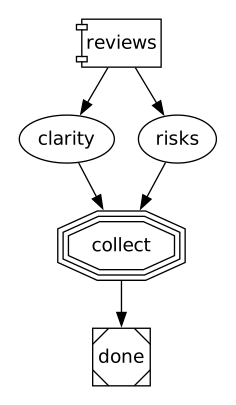
reviews forks into clarity and risks; both meet at collect, which summarises them and reaches done.
How the fan-out works
Section titled “How the fan-out works”reviews is a component, and each of its bare outgoing edges starts a branch, up to max_parallel at a time. Every branch must reach the same tripleoctagon join without a cycle, a nested fan-out or an edge escaping the branch.
Each branch keeps its own context, so clarity cannot read what risks produced. After the join, results arrive in edge order under parallel.results with node, outcome, failure reason and context. The join prompt here reads {{ context.parallel.results['0'].context.assessment }}; the index is quoted, and the complete example validates that spelling.
Set max_parallel to the number of concurrent turns your provider supports. If branches must write, give them disjoint files and review the combined result after the join. Add a conditioned failure edge on the fan-out when partial completion has a safe recovery; otherwise Orbital holds and names the failed branches.
Save, validate and run
Section titled “Save, validate and run”Download all files. Create a local Git practice repository. It needs no remote:
mkdir -p ~/orbital-parallel-reviews/.orbitalgit init ~/orbital-parallel-reviewscd ~/orbital-parallel-reviewsExtract the archive into ~/orbital-parallel-reviews/.orbital/. Keep every relative path. From ~/orbital-parallel-reviews run:
orbital validate .orbital/workflow.dotAdd the project folder in Orbital. On New run select the project and workflow graph, choose your authenticated harness and supply the goal. Use a separate practice project for each example so the workflow name is unambiguous.
Expected behaviour
Section titled “Expected behaviour”Both reviews run. Their assessment outputs stay inside parallel.results. The collect turn summarises both before done.
Complete source
Section titled “Complete source”Every DOT file below is a complete runnable graph. The archive contains the same files. Prompt files are companions, not separate workflows.
workflow.dot
Section titled “workflow.dot”digraph reviews { graph [version="1", entry="reviews"] reviews [shape="component", max_parallel="2"] clarity [prompt="Review the goal for clarity. Read only; do not change files.", outputs="assessment:text"] risks [prompt="Review the goal for risks. Read only; do not change files.", outputs="assessment:text"] collect [shape="tripleoctagon", prompt="Summarise these reviews: {{ context.parallel.results['0'].context.assessment }} and {{ context.parallel.results['1'].context.assessment }}"] done [shape="Msquare"] reviews -> clarity reviews -> risks clarity -> collect risks -> collect collect -> done}Validate after changing branch boundaries. See parallel constraints.