

Add branches
Send a run to different steps with conditions on its edges
Send a run to different steps depending on what it has just learned. Put a condition on each edge that leaves the step, and the run follows the first one that matches.
classify [prompt="If the goal asks for a greeting, choose greet. Otherwise choose explain.", outputs="route:choice"]classify -> greet [condition="route == 'greet'", weight="2"]classify -> explain [condition="route == 'explain'", weight="1"]How conditions choose the next step
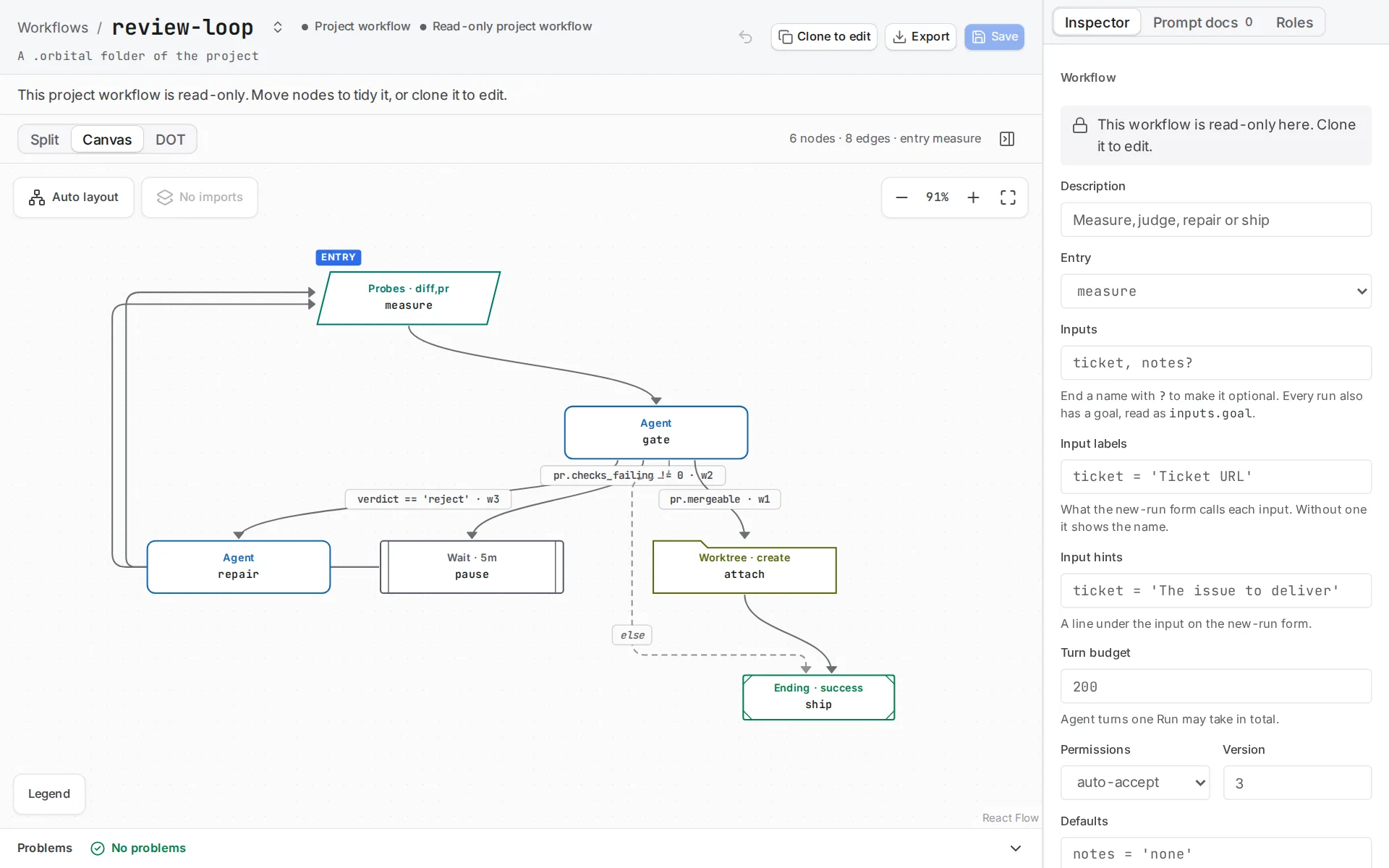
Section titled “How conditions choose the next step”Routing lives on edges, not in a decision node. Each edge that leaves a step either carries a condition or is the fallback. A condition compares one context value with a literal, such as verdict == 'pass', or tests a value on its own, such as pr.mergeable.
When a step succeeds, Orbital tries its conditioned edges from the highest weight down and takes the first match. Only then does it consider the fallback. Two conditioned edges from one step cannot share a weight.
You cannot combine conditions or compare two context values, so every route stays readable in the workflow. The condition entry lists every form a condition takes.
Choose what to branch on
Section titled “Choose what to branch on”Decide first what produces the value you branch on. The answer changes the cost and the reliability of the branch.
- Use a built-in probe when Orbital already observes the fact. The ticket workflow routes on pull request state without asking an agent whether a merge happened.
- For another exact observation, use a script command with declared
bool,numberortextfacts. Its last line of output must be the JSON object exactly as declared. Keep the script read-only when it only inspects something. - For judgement, give an agent a
choiceoutput. Orbital takes the allowed values from the conditions on the step’s outgoing edges and refuses any other answer. Sooutputs="verdict:choice"with edges forpassandrejectaccepts nothing else.
A probe or a script gives an exact answer at no agent cost. The example below branches on judgement, so an agent makes the choice.
Cover every case
Section titled “Cover every case”A branching step needs a fallback, an edge with no condition, unless its conditions already cover every value of its choice output. A run where no edge matches stops with an error, so validation asks for the fallback before the run starts.
Before you start
Section titled “Before you start”You need a harness you have signed in to, and a project in Orbital. Any project works. It does not need to be a Git repository, unless you run the example with Codex, which needs one. See Projects and folders.
1. Download the example
Section titled “1. Download the example”Download the example and unpack it into ~/.orbital/workflows/. Keep every relative path.

digraph conditional { graph [version="1", entry="classify"] classify [tool_access="Read only", prompt="If the goal asks for a greeting, choose greet. Otherwise choose explain.", outputs="route:choice"] greet [tool_access="Read only", prompt="Write a friendly greeting."] explain [tool_access="Read only", prompt="Explain the goal in one sentence."] done [shape="Msquare"] classify -> greet [condition="route == 'greet'", weight="2"] classify -> explain [condition="route == 'explain'", weight="1"] greet -> done explain -> done}classify declares outputs="route:choice". Orbital takes the allowed values, greet and explain, from the conditions on its outgoing edges, and refuses any other answer before it reaches context. The two edges carry different weights, so the higher one is tried first. The conditions cover every allowed value, so this step needs no fallback.
Every step has the Read only tool access, so none of them can change files. Codex can run commands to read files because its read-only sandbox prevents writes.
2. Validate it
Section titled “2. Validate it”orbital validate ~/.orbital/workflows/conditional.dot3. Run it
Section titled “3. Run it”Choose New task, pick any project, and choose the conditional workflow and your harness. One project serves every example. Use a greeting as the goal to select greet, or any other goal to select explain.
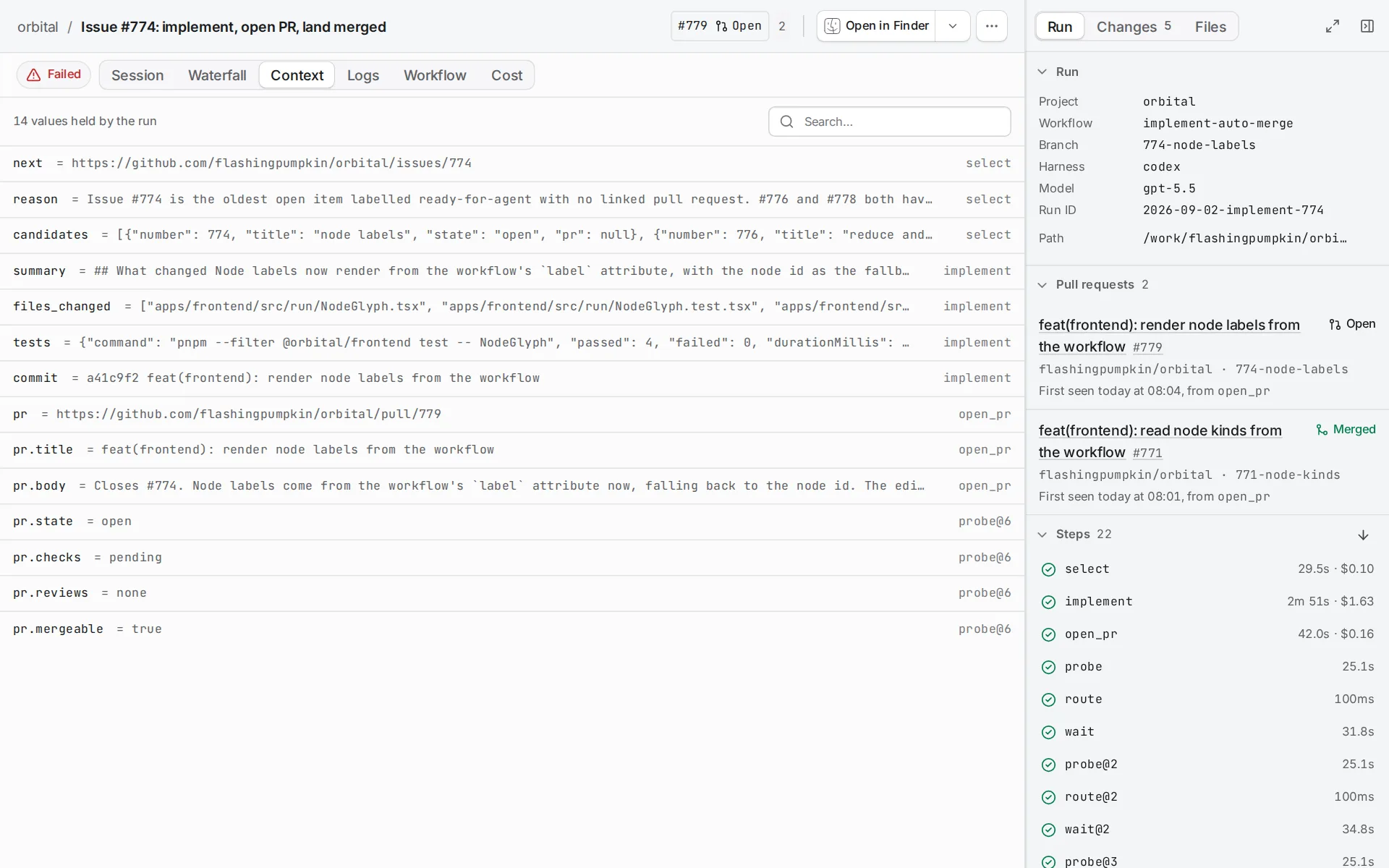
Exactly one response step runs before done. The run’s Context tab shows each value the run holds and the step that set it.
Related
Section titled “Related”condition: every form a condition takes, and the fallback rules.- Add a loop: send rejected work back for repair, with a bound.
- Pass context between steps: the values a condition can read.
- Error handling: what happens when a step fails.